
Reveries Revisited: Part Two
The imaginal realm . . .

About the series:
Hello everyone. This week I am sharing a section from my second book The Tarot: Methods, Mastery, and More. It was published thirty years ago—and looking at it now, I see both echoes of the 1960s and premonitions of our present reality.
Which makes it worth another look, I’ve decided.
So—reminded/intrigued by a recent release of material related to “UAPs” (Unexplained Aerial Phenomena)—I’m reprinting a section of MMM that was originally sparked by public fascination with UFOs.
The explicit Tarot connections come late in the section, but I decided to begin at the beginning and share the whole thing in three parts. Not sure how I feel about the writing style (?) but here is the unedited original text, with the note numbers left in. The citations will be in Part Three.
As you read, I invite you to remember this was written three decades ago, balanced on the edge of a world-shift that we are only beginning to appreciate.
Here’s a link to Part One:

And now . . . .
Cosmic Tarot and the Coming Millennium: Part Two
Like Kenneth Ring and Michael Grosso, John Mack says forthrightly that he does not know exactly what alien abductions are or what they might mean. But each of these researchers contends that something real and important is happening—though not, perhaps, in the dimensions of space-time that we’re familiar with.
Ring adds a fascinating dimension to the study of extraordinary encounters by suggesting they may be visits to an imaginal realm such as that posited by French Islamic scholar Henry Corbin.¹⁷ Ring stresses that the imaginal realm he refers to is in no sense “imaginary”; it is, rather, a different kind of reality, perceptible to us only in altered states of consciousness such as mystical experience, shamanic ecstasy, or near-death.
As Corbin describes it, the imaginal world “is hidden behind the very act of sense perception and has to be sought underneath its apparent objective certainty.” Just as the physical “real” world is available to us by way of our sensory organs, the imaginal world is available to us by way of imaginative perception, or what Corbin calls the “psychospiritual senses.”
If, as some argue, we visit the imaginal world in dreams, then it appears we all have a natural ability to move back and forth between the material and imaginal realms. We can also cultivate ways of strengthening the imagination and traveling regularly into the imaginal realm, as practitioners of magic and other sacred technologies have long done. However, Ring believes that we as a species are moving more and more into contact with the imaginal world and that extraordinary encounters are both a cause and an effect of this evolutionary process.
The content of these experiences seems mysterious (Who or what are the “aliens”? What or where is the “light” encountered by so many near-death experiencers?) because the experiencers are being drawn into a world for which we have no rational points of reference. But the continuity and increasing frequency of the experiences, according to Ring, suggest that they are part of a “major shift in levels of consciousness that will eventually lead to humanity’s being able to live in two worlds at once—the physical and the imaginal.”
Ring is the first to say that these are extreme speculations, but he is only one of many thinkers today who are probing the extremes. Gary Zukav, in his book The Seat of the Soul, comes from a different direction to make a point that complements Ring’s evolutionary thesis. Zukav believes that we are evolving from five-sensory humans into multisensory humans.
Our five senses, together, form a single sensory system that is designed to perceive physical reality. The perceptions of a multisensory human extend beyond physical reality to the larger dynamical systems of which physical reality is a part. The multisensory human is able to perceive, and to appreciate, the role that our physical reality plays in a larger picture of evolution, and the dynamics by which our physical reality is created and sustained. This realm is invisible to the five-sensory human.
Meanwhile, Terrence McKenna, shamanic explorer and psychedelic theorist, offers yet another—and more immediate—view of evolution when he predicts that “sometime around the end of 2012 all of this [the globalization of culture, the information explosion, etcetera] will be boiled down into a kind of alchemical distillation of the historical experience that will be a doorway into the life of the imagination.”
Rather like Ring, McKenna believes that “we’re moving toward something very much like eternal dreaming, going into the imagination, and staying there.” Another well-known researcher into the mysteries of consciousness, John White, asserts that “human beings are also human becomings,” divided today into an old and new species—a dominant species which is ego-oriented and self-destructive, an emerging species (Homo noeticus) which is “life-embracing.”¹⁸
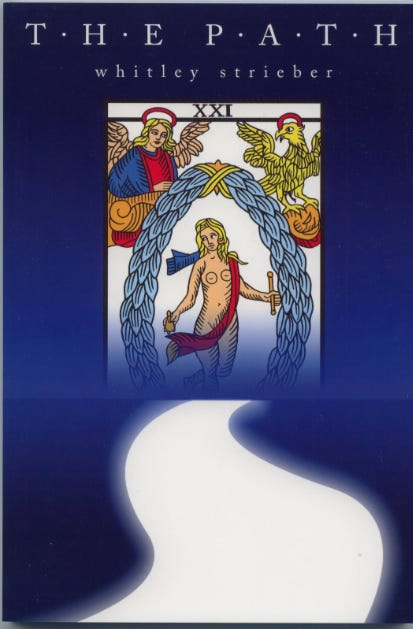
Let’s now begin to connect all these intriguing speculations with the Tarot. By reason of his obvious intelligence and apparent sincerity, Whitley Strieber . . . .
Find out in Part Three. C
I'm really enjoying this. Have you taken a look at the YouTube series called the Telepathy Tapes that are looking at unusual means of communication among nonverbal autists and other people? It's well-researched and presented. I wandered into it almost a year ago and found myself muttering "but I've done that..." from time to time. This is all part of an intriguing synchrocity for me.
I’m really loving this , Cynthia. I first read Teillard de Chardin after a mystical experience when I was 18 & it made good sense, despite his wonky politics. That was many years ago now. And I still find myself uplifted by the way you & others ‘see’ the world and our experience within it. I look forward to tomorrow’s installment. AJS